


Domiciliary care — also known as home care — is one of the fastest-growing sectors in the UK. With an ageing population and a sustained policy preference for supporting people to remain in their own homes, demand for domiciliary care services has never been higher.
But before you can begin providing personal care to clients in their homes, you must be registered with the Care Quality Commission (CQC). This is not optional. Providing a regulated activity — including personal care — without CQC registration is a criminal offence under the Health and Social Care Act 2008.
This guide covers everything you need to know about domiciliary care CQC registration in 2026: what is required, the step-by-step process, key documents, timelines, and the most common reasons applications fail.
| What counts as ‘domiciliary care’ for CQC purposes? |
| The CQC regulates the provision of ‘personal care’ as a regulated activity under Schedule 1 of the Health and Social Care Act 2008 (Regulated Activities) Regulations 2014. Personal care includes: assisting with washing, dressing, eating, oral hygiene, toileting, and administering medication. If your service provides any of these activities to people in their own homes, you must register with the CQC before you begin. |
Before You Apply: What You Need to Have in Place
Many applicants submit their CQC registration application before their business is properly structured. This is one of the most common causes of delays and refusals. Before you begin your application, the following must be in place:
Legal Structure
Your business entity must be formally established before you can register as a CQC provider. This means your limited company must be incorporated at Companies House, your partnership agreement must be in place, or your sole trader registration must be complete. The CQC will ask for your Companies House registration number and will verify your entity independently.
Registered Manager
For most domiciliary care agencies, you will need a named Registered Manager — an individual who is separately registered with the CQC and takes day-to-day responsibility for the service. The Registered Manager must meet the CQC’s fit and proper person requirements and hold appropriate qualifications, typically a Level 5 Diploma in Leadership for Health and Social Care or equivalent.
If you intend to be both the provider and the Registered Manager, you can apply for both registrations simultaneously. If you are appointing a separate individual as Registered Manager, they must be involved in the application process from the start.
Premises
Domiciliary care agencies typically operate from an office base rather than a residential premises. The CQC will want to know where your administrative base is located. Unlike care homes, you do not need to have a specific premises inspection for a domiciliary care registration — but your office address must be real, functioning, and able to receive correspondence.
Insurance
You must have employers’ liability insurance (legally required if you have employees) and public liability insurance before you submit your application. The CQC will ask for evidence of both.
The Application Process: Step by Step
| STEP | WHAT TO DO | NOTES |
|---|---|---|
| 1. Create CQC portal account | Go to cqc.org.uk and register for an online account as a new provider. | Use your business email address, not a personal one. |
| 2. Start the provider application | Select ‘Register as a new provider’. Choose ‘Personal care’ as your regulated activity. Select ‘Domiciliary care’ as your service type. | You can save and return — the application does not need to be completed in one session. |
| 3. Complete your Statement of Purpose | This is the most important document in your application. It must describe your service in detail — client group, geographic area, staffing model, aims, objectives, and how you will meet the five CQC key questions. | Allow at least 3–5 days to write this properly. Generic templates will not pass CQC scrutiny. |
| 4. Complete the Registered Manager application | If a separate RM is being registered, they must complete their own application in the CQC portal, linked to your provider application. | Both applications are assessed together. The RM application can run in parallel with the provider application. |
| 5. Upload supporting documents | Upload all required policies, procedures, insurance certificates, DBS certificates, qualifications, and financial evidence through the portal. | See the full document checklist in the next section. |
| 6. Pay the registration fee | The CQC charges an annual fee based on your service type and size. For a single-location domiciliary care agency, this is typically £1,500–£2,500. | The fee is non-refundable even if your application is unsuccessful. |
| 7. CQC assessment | The CQC will review your application and may contact you with queries. They may arrange an interview with the Registered Manager to assess fitness. | Respond to all CQC queries promptly — delays in responding extend your timeline significantly. |
| 8. Registration decision | The CQC will grant registration (with or without conditions), propose to refuse, or request further information. | Registration typically takes 10–16 weeks from submission of a complete application. |
Documents You Must Submit
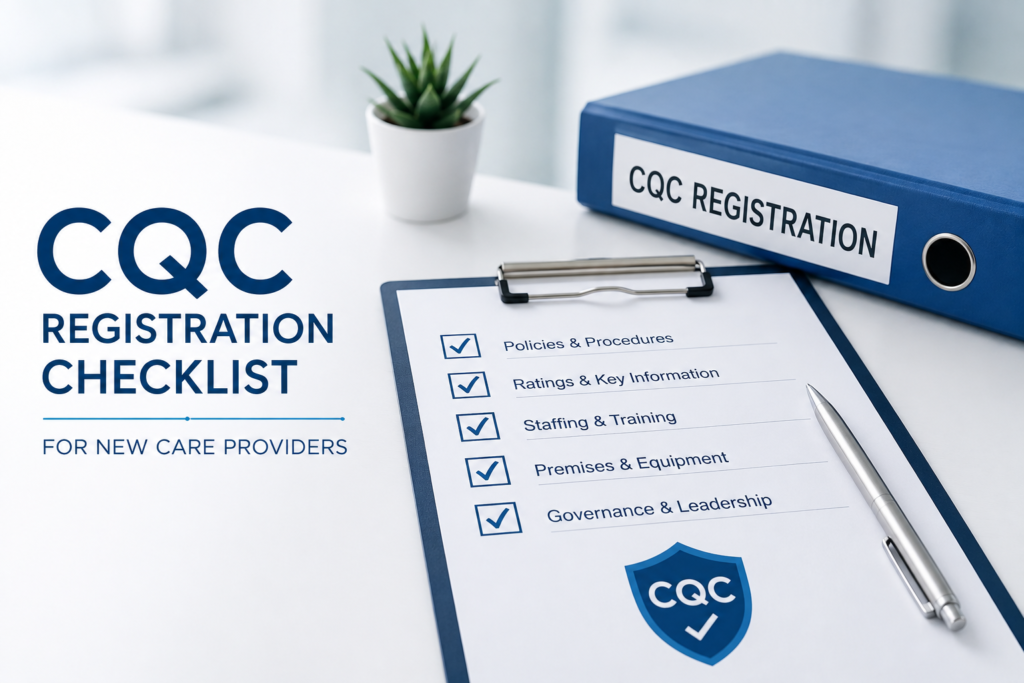
Incomplete documentation is the single most common reason domiciliary care CQC applications are delayed. Have all of the following ready before you submit:
Mandatory for All Domiciliary Care Applications
- Statement of Purpose — minimum 10–15 pages, covering all required elements
- Safeguarding adults policy and procedure
- Medicines management policy (including administration, storage, and disposal)
- Infection prevention and control policy
- Complaints policy and procedure
- Whistle-blowing policy
- Consent and mental capacity policy
- Lone worker policy (essential for domiciliary care)
- Recruitment and selection policy including DBS check procedure
- Staff supervision and appraisal policy
- Training and development policy
- Risk assessment policy
- Business continuity plan
- Enhanced DBS certificate for the Registered Manager (within the last 12 months)
- Proof of qualifications for the Registered Manager
- Two professional references for the Registered Manager
- Employers’ liability insurance certificate
- Public liability insurance certificate
- Evidence of financial viability — bank statements (3 months minimum), business plan with financial projections, or accountant’s letter
| Important: Policies Must Reflect Your Actual Service |
| The CQC specifically looks for policies that are customised to your service model, client group, and geographic area. Generic downloaded templates where only the company name has been changed are routinely identified by CQC assessors and are a frequent cause of delays. Every policy must reference your specific service — for example, your lone worker policy should reflect the actual risks faced by care workers visiting clients in their homes in your target area. |
The Fit and Proper Person Assessment for Domiciliary Care
The CQC will assess whether both the provider and the Registered Manager are ‘fit and proper persons’ to run or manage a regulated domiciliary care service. For domiciliary care specifically, the CQC pays close attention to:
- Previous regulatory history — any involvement in a domiciliary care, care home, or other regulated service that received an Inadequate rating, enforcement action, or cancellation of registration
- Criminal record — particularly any offences involving dishonesty, violence, or safeguarding-related matters. You must declare all unspent convictions
- Financial history — any county court judgements (CCJs), individual voluntary arrangements (IVAs), or history of insolvency in regulated roles
- Employment gaps — any unexplained periods not in employment, education, or training must be accounted for
- References — the CQC may contact your references directly and cross-reference what they say against your declared history
How Long Does Domiciliary Care CQC Registration Take?
For a well-prepared, complete application, domiciliary care CQC registration typically takes 10–16 weeks from the date of submission. The CQC’s published service standard is 10 weeks, but in practice most applications take longer due to query resolution and assessment capacity.
The factors that most reliably extend the timeline are:
- Submitting an incomplete application — even a missing document can pause the process while the CQC waits for it
- A vague or generic Statement of Purpose that requires revision
- Gaps in the Registered Manager’s employment history that require clarification
- High application volumes at the CQC — particularly common in Q1 and Q4
- Queries raised during the assessment interview that require written follow-up
The most reliable way to achieve the shortest timeline is to submit a complete, professionally prepared application on the first attempt. Elberra Consulting regularly supports clients to achieve registration in the 10–12 week range through thorough pre-submission preparation.
Common Reasons Domiciliary Care CQC Applications Fail
- The Statement of Purpose does not demonstrate how the service will meet each of the five CQC key questions (Safe, Effective, Caring, Responsive, Well-led).
- Policies are clearly generic templates rather than service-specific documents.
- The Registered Manager does not have adequate qualifications or experience for the scale and complexity of the proposed service.
- Financial viability evidence is insufficient — a vague business plan without financial projections, or bank statements showing inadequate capital runway.
- The provider or Registered Manager has undisclosed regulatory history that the CQC identifies through its own checks.
- DBS certificates are outdated or the Registered Manager’s identity documents do not match their declared history.
- The application is submitted before the business infrastructure (insurance, premises, staffing plan) is properly in place.
How Elberra Consulting Supports Domiciliary Care CQC Registration
Elberra Consulting has guided domiciliary care providers through every stage of the CQC registration process. Our support service includes:
- Pre-application readiness review — assessing your business structure, proposed model, and management arrangements before submission
- Statement of Purpose drafting — a comprehensive, CQC-compliant Statement of Purpose written specifically for your service
- Full policy and procedure package — a complete suite of domiciliary care-specific policies, not generic templates
- Fit and proper person coaching — preparing the Registered Manager for the CQC assessment interview
- Application portal completion — guiding you through every question in the CQC online application
- Post-submission query management — handling CQC queries and follow-up correspondence on your behalf
Starting a domiciliary care agency? |
| Book a free initial consultation with our CQC registration specialists. We will review your proposed service model, advise on any gaps, and outline exactly what you need to achieve a successful first-time submission. |
| Book your free CQC consultation → elberraconsulting.co.uk/free-consultation/ |
Frequently Asked Questions
Do I need a physical office to register a domiciliary care agency with the CQC?
Yes. You need a registered business address that can receive correspondence. It does not need to be a large premises, but it must be a real, functioning address — not a PO box or virtual mail-only address. Many small domiciliary care agencies operate from a home office initially, which the CQC will accept provided it is clearly identified as your administrative base.
Can I register my domiciliary care agency before I have any clients?
Yes — and in fact you must register before you begin providing care to clients. You can apply for CQC registration before your service is fully operational, provided your business entity is established, your Registered Manager is in place, and all required documentation is ready. You cannot, however, begin providing personal care to clients until registration is granted.
Does my Registered Manager need to live near the service area?
The CQC does not specify a geographic requirement for the Registered Manager’s location, but expects the RM to have adequate oversight of the service. For domiciliary care, this means the RM must be reachable and responsive to issues arising in the service area. If your RM is based far from the operational area, the CQC may ask how effective oversight will be maintained.
What happens if my Registered Manager leaves after registration is granted?
You must notify the CQC immediately if your Registered Manager leaves or their registration lapses. You have a legal obligation to either appoint a new Registered Manager and apply for their registration, or to apply for a temporary arrangement. Operating a regulated service without a Registered Manager in post (unless the CQC has approved a temporary manager arrangement) is a breach of your registration conditions.