



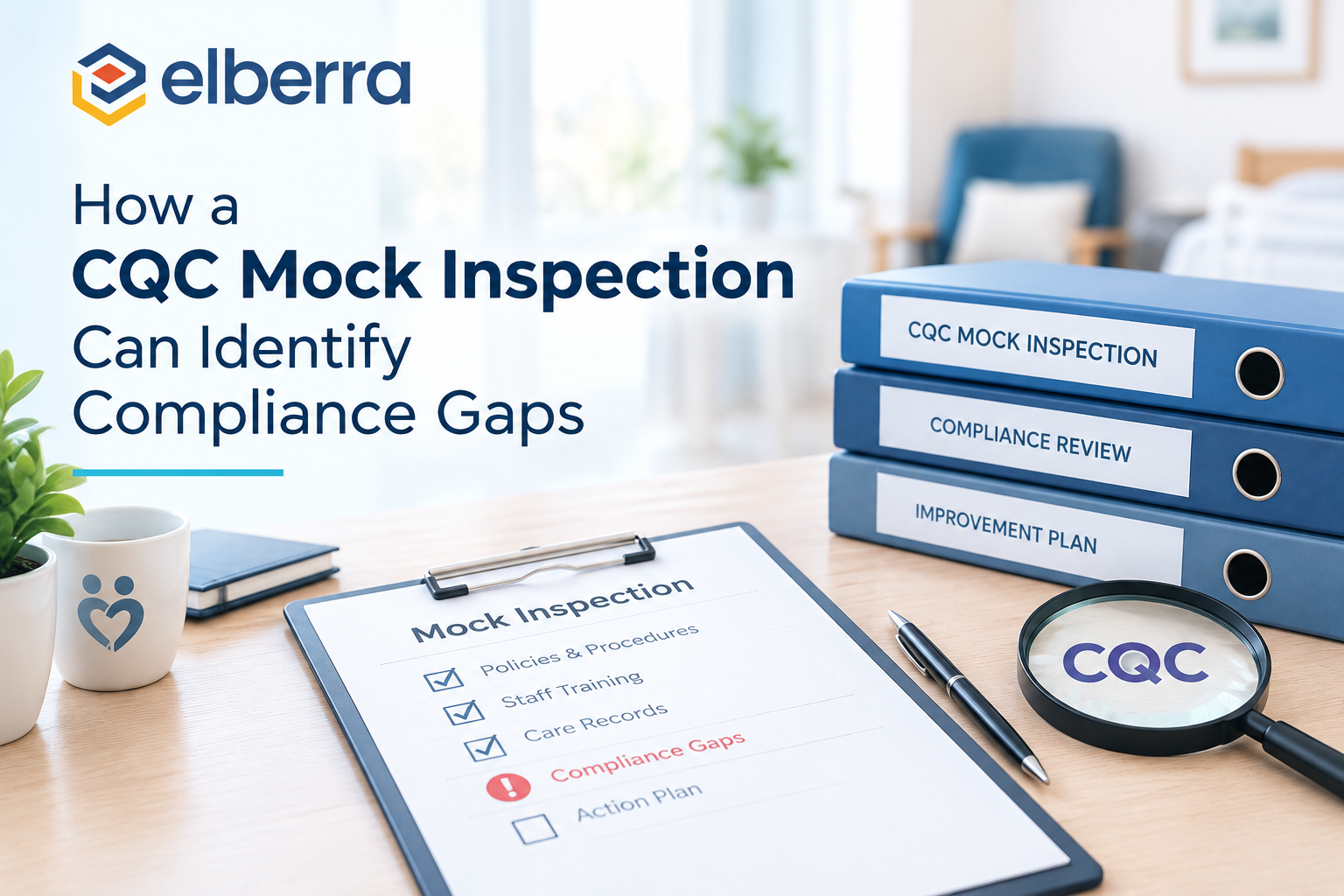
A CQC mock inspection gives health and social care providers an opportunity to assess their service before a real CQC assessment takes place. Rather than waiting for an inspector to identify weaknesses, a mock inspection provides an independent review of how your service operates, what evidence it can produce, and whether staff can demonstrate their understanding of key responsibilities.
A well-conducted mock CQC inspection looks beyond policies and paperwork. It considers whether your systems are actually being followed in practice and whether your records, staff knowledge, care delivery, governance, and environment provide consistent evidence of good practice. This makes a mock inspection a useful part of CQC inspection preparation and ongoing compliance management.
What Is A CQC Mock Inspection?
A CQC mock inspection is a structured compliance assessment designed to replicate relevant elements of a regulatory assessment. An independent reviewer examines the service through documentation reviews, staff discussions, observations, management interviews, and checks of operational systems.
The purpose is not to predict exactly what CQC will do on the day. Instead, it is to test whether your service can demonstrate that it is meeting applicable regulatory requirements and identify areas where evidence, systems, or practice need improvement.
Depending on the service and the scope of the review, a mock inspection can be conducted onsite or virtually. An onsite review can assess the physical environment and observe care delivery directly, while a virtual review can cover areas such as documentation, governance, management discussions, staff interviews, and evidence checks. The appropriate format depends on the service and what needs to be assessed.
For providers, this creates a useful distinction between having a policy and being able to demonstrate that the policy works in practice.
Comparing Policy With Actual Practice:-
One of the most valuable aspects of a mock inspection is testing whether written procedures reflect what happens every day.
A provider may have a comprehensive safeguarding policy, for example, but staff may be unclear about how to report a concern. Similarly, a care plan may describe a person’s current needs while daily records show that staff are following an outdated approach.
A reviewer can observe routines, speak with staff, examine the environment, and compare these findings with the provider’s documented procedures. This can expose CQC compliance gaps that may not be obvious from a document-only review.
Common discrepancies can include:
- Policies that have not been updated to reflect current practice
- Staff following different procedures for the same task
- Risk assessments that do not match current risks
- Care plans that have not been updated after a change in need
- Governance processes that exist on paper but are not consistently followed
Identifying these differences early gives management an opportunity to correct them and improve consistency.
Assessing The Five Key Questions:-
A structured care compliance review should consider the five key questions used by CQC: Safe, Effective, Caring, Responsive and Well-led.
Safe
The review may examine safeguarding, medicines management, infection prevention and control, risk assessments, staffing arrangements, incidents, and the safety of the care environment.
Effective
This includes areas such as care planning, consent, staff competence, nutrition, monitoring of outcomes, and whether care is delivered in accordance with people’s assessed needs.
Caring
Reviewers may consider whether staff demonstrate dignity, respect, compassion, person-centred care, and appropriate communication with people receiving support and their families.
Responsive
This looks at how the service responds to individual needs, feedback, complaints, changing circumstances, and people’s preferences.
Well-Led
Governance, leadership, quality assurance, audits, risk management, accountability, and continuous improvement are considered to establish whether management has effective oversight of the service.
CQC Assessment Framework Is Changing:-
Providers should also be aware that CQC’s assessment approach is evolving. The current approach uses the five key questions alongside quality statements, evidence categories and scoring. CQC has also been testing a new assessment method designed to better reflect the different sectors and services it regulates.
CQC’s structured programme of pilots and testing is running from June to October 2026, with final evaluation planned for November 2026. The pilot assessments are being conducted alongside, rather than instead of, existing inspections, and the new approach is being refined before wider implementation.
For providers, this means CQC inspection preparation should not rely on a fixed checklist alone. Services should be able to demonstrate good practice through reliable evidence, staff knowledge, people’s experiences, effective governance, and what happens in day-to-day care. Keeping systems under regular review can help providers remain prepared as CQC’s assessment approach develops.
Testing Staff Knowledge Through Interviews:-
Documentation can appear complete while staff knowledge reveals a different picture. During a mock CQC inspection, reviewers can speak directly with care workers, nurses, managers, and other relevant team members. Questions may explore how staff would respond to a safeguarding concern, what they would do if a person’s needs changed, how they report incidents, or how they raise concerns through whistleblowing procedures.
These conversations can identify:
- Gaps in mandatory or service-specific training
- Staff who are unsure about escalation procedures
- Inconsistent understanding of safeguarding responsibilities
- Weak communication between management and frontline teams
- Policies that staff have not read or understood
- Uncertainty around recording and reporting requirements
The purpose is not to catch individual employees out. It is to establish whether the organisation’s systems have been effectively communicated and embedded.
Reviewing Documentation And Evidence:-
A provider needs more than good intentions to demonstrate compliance. It needs evidence. During an inspection readiness review, relevant documentation may be examined to determine whether records are complete, current, consistent, and properly followed up. Depending on the service, this could include care plans, risk assessments, medication records, staff files, training records, incident reports, complaints, audits, meeting records, and maintenance documentation.
The review may identify relatively small issues that point towards wider governance weaknesses, such as:
- Missing review dates or signatures
- Outdated care plans
- Incomplete medication records
- Expired staff training
- Risk assessments without evidence of review
- Audit findings without documented follow-up
- Complaints without clear evidence of action
- Incident records that do not show learning or escalation
These are not simply administrative problems. When documentation does not accurately reflect how a service operates, it becomes harder for management to demonstrate effective oversight.
Identifying Gaps In Governance And Quality Assurance:-
Some of the most important CQC compliance gaps are found within management systems rather than frontline care.
A provider may conduct regular audits but fail to record actions arising from them. Alternatively, an action plan may exist but contain no clear owner or completion date. This makes it difficult to demonstrate that identified risks are being addressed.
A mock inspection can examine whether your governance cycle is working:
Identify – > Record – > Act – > Review – > Improve
For example, if an audit identifies repeated medication recording errors, the reviewer can look at whether management investigated the cause, implemented corrective action, checked whether the problem improved, and documented the outcome.
This helps distinguish genuine continuous improvement from compliance activity that exists mainly on paper.
Checking The Care Environment:-
A mock CQC inspection can also identify physical and environmental issues that may be overlooked during routine operations.
Depending on the service, reviewers may examine cleanliness, infection control arrangements, equipment, signage, storage, emergency procedures, accessibility, maintenance records, and other aspects of the environment relevant to safe care.
Staff and managers can become accustomed to their own surroundings, which makes an independent review useful. A fresh perspective can highlight issues that internal teams have stopped noticing.
Where the service or scope of the review makes an onsite assessment appropriate, this physical review can be an important part of identifying gaps that cannot be fully assessed remotely.
Turning Findings Into An Action Plan:-
Finding a gap is only the first step. The value of a compliance assessment depends on what happens afterwards.
A useful mock inspection report should distinguish between areas that are working well and those requiring attention. Each significant finding should then be translated into a practical action with a clear responsibility and timescale.
A simple improvement plan might include:
| Finding | Required Action | Owner | Review |
| Outdated risk assessments | Review current risks and update records | Registered Manager | 30 days |
| Staff training gaps | Complete outstanding training | Training Lead | 14 days |
| Incomplete audit actions | Assign owners and completion dates | Quality Manager | 30 days |
The action plan should then be reviewed rather than filed away. This creates a clear link between identifying a weakness and demonstrating that the organisation has responded.
Why Independent Review Matters?
Internal audits are important, but an external perspective can identify issues that people working within the service may overlook.
An independent reviewer can challenge assumptions, ask staff questions that managers may not consider, compare practice against regulatory expectations, and assess whether evidence supports the service’s claims about its own performance.
This can make a care compliance review particularly useful before an inspection, after significant organisational changes, or when a provider has identified recurring compliance concerns.
When Should You Arrange A Mock CQC Inspection?
A mock inspection does not need to be reserved for the weeks immediately before CQC visits.
It can be useful when:
- You are preparing for an upcoming inspection or assessment.
- Your service has recently opened or undergone significant change.
- There has been a change in Registered Manager or senior leadership.
- Internal audits have identified recurring concerns.
- Your service has received regulatory concerns or requires improvement.
- You want an independent review of your governance arrangements.
- You want to test whether previous improvement actions have been effective.
Regular reviews can also form part of a broader CQC inspection preparation programme.
Make Inspection Readiness Part Of Everyday Compliance:-
A mock inspection should not be treated as a one-off exercise designed to make a service look prepared for a particular inspection. Its greater value comes from identifying weaknesses in systems and helping management address them before they affect people receiving care.
When findings are followed by clear actions, staff training, updated documentation, stronger governance, and ongoing monitoring, the process becomes part of continuous improvement.
The aim is not to create paperwork specifically for CQC. It is to make sure that your policies, records, staff practice, leadership, and quality systems accurately demonstrate how your service operates every day.
Conclusion:-
A CQC mock inspection provides an opportunity to see your service from an independent perspective before regulatory scrutiny. By comparing policies with actual practice, testing staff knowledge, reviewing documentation, assessing governance, and examining the care environment, it can reveal gaps that may otherwise remain unnoticed.
The most important part is what you do with the findings. A clear action plan, accountable management, staff involvement, and follow-up monitoring can turn identified weaknesses into measurable improvements.
With CQC’s assessment approach also developing through sector-specific framework testing, providers should focus on maintaining strong evidence, effective systems, knowledgeable staff, and good day-to-day practice rather than preparing for a single fixed inspection format.
Elberra Consulting provides CQC mock inspections and practical compliance support for health and social care providers across England, with onsite and virtual options depending on the service and requirements.
Speak with our specialists to assess your current inspection readiness and identify the areas that need attention before CQC does.
Frequently Asked Questions
What Does A CQC Mock Inspection Include?
A CQC mock inspection can include documentation reviews, staff interviews, observations, governance checks, care record reviews, environmental checks, and an assessment against relevant regulatory expectations. The exact scope depends on the type of service and the areas that need to be reviewed.
How Long Does A CQC Mock Inspection Take?
The duration depends on the size and type of service, the number of locations, the scope of the review, and whether the assessment is carried out onsite or virtually. A focused review may require less time, while a more comprehensive assessment of a larger or more complex service may take longer. Elberra Consulting can agree the appropriate scope and expected duration with you before the mock inspection begins.
Can A CQC Mock Inspection Be Carried Out Virtually?
Yes. Depending on the service and the areas being assessed, Elberra Consulting can provide virtual or onsite mock inspections. A virtual review can include document checks, management discussions, staff interviews, governance reviews, and assessment of relevant evidence. An onsite inspection may be more appropriate where the physical environment, equipment, premises, or day-to-day care delivery needs to be observed directly.
Can A Mock Inspection Identify Hidden Compliance Gaps?
Yes. An independent review can compare written policies with actual practice, test staff knowledge, examine evidence trails, and identify inconsistencies that routine internal checks may miss.
How Often Should A Care Provider Have A Mock Inspection?
There is no universal frequency. The appropriate approach depends on the service, risk profile, regulatory history, internal audit findings, organisational changes, and previous inspection outcomes. Some providers may benefit from periodic reviews as part of their wider compliance programme rather than treating a mock inspection as a one-off exercise.
What Happens After A Mock CQC Inspection?
The findings should be converted into a prioritised improvement plan. Actions should have clear ownership and timescales, with follow-up checks to establish whether identified issues have been resolved. The aim is to turn findings into measurable improvements rather than simply produce another compliance report.
Is A Mock Inspection The Same As A CQC Inspection?
No. A mock inspection is an independent preparation and improvement exercise. It does not replace an assessment conducted by CQC or guarantee a particular regulatory outcome.