



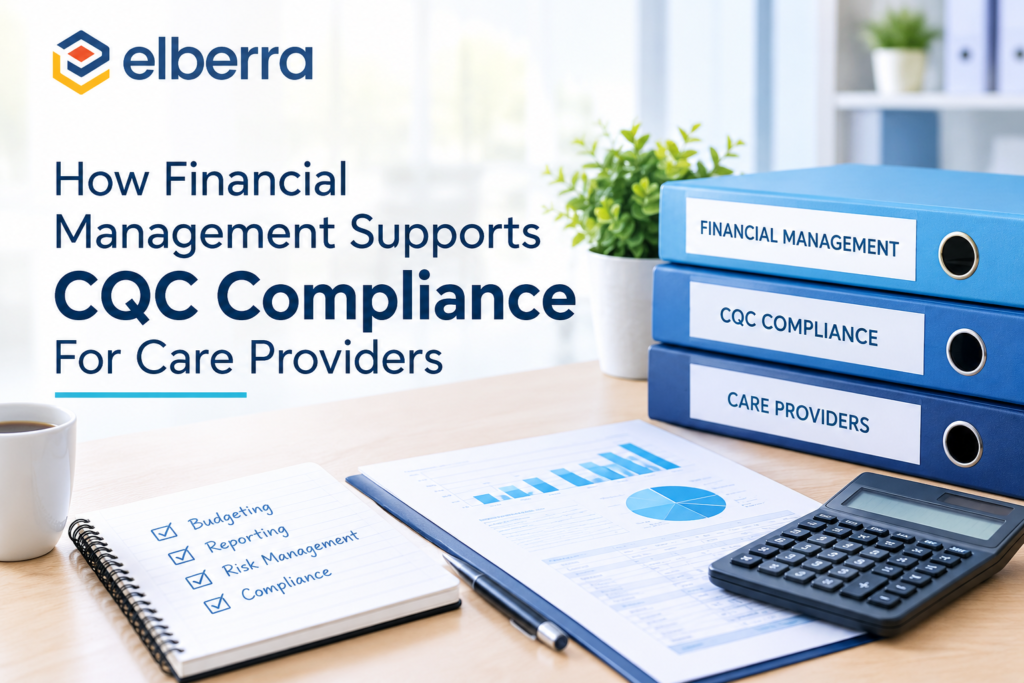
Running a care home is a complex financial undertaking. Unlike most businesses, care homes operate in a highly regulated environment where financial management intersects directly with regulatory compliance — where the quality of your accounts can influence your CQC registration, your commissioning relationships, and your ability to attract investment or secure financing.
This guide covers the key elements of care home financial management: from the specific accounting challenges of the care sector to the financial reports your business needs, the CQC financial viability requirements, and how to structure your finances for long-term sustainability.
| Who this guide is for |
| This guide is written for care home owners, operators, and directors who want to understand the financial management requirements specific to residential and nursing care — and how to build a finance function that supports both operational performance and regulatory compliance. |
Why care home accounting Is Different
Care home accounting differs from standard business accounting in several important ways. Understanding these differences is the starting point for building an effective financial management function.
- Multiple funding streams: Most care homes receive income from a combination of local authority-funded residents, NHS-funded placements, and privately paying residents. Each funding stream has different rates, different payment timescales, and different contractual terms. Your accounting system must be able to track income and costs at this level of granularity.
- High fixed cost base: Care homes are labour-intensive businesses with significant fixed costs — predominantly staff wages and property costs. Understanding your cost structure and break-even occupancy level is fundamental to financial management.
- Occupancy-driven revenue: Revenue is directly linked to occupancy. Managing the financial impact of void beds, admission delays, and resident turnover requires careful cashflow planning.
- Regulatory financial requirements: The CQC requires providers to demonstrate financial viability as part of registration and ongoing monitoring. Local authority commissioners increasingly require financial transparency as part of contract management. Your accounts must be able to meet these requirements.
- Staff cost complexity: care homes typically employ large numbers of staff across multiple shift patterns, including bank and agency staff. payroll is often the largest single cost and requires specialist management.
Essential Financial Reports Every Care Home Needs
A well-managed care home should be producing the following financial reports on a regular basis:
Monthly Management Accounts
Monthly management accounts are the foundation of effective care home financial management. They should include: a profit and loss statement comparing actual performance against budget, a balance sheet, a cashflow statement, and an occupancy analysis showing bed days, occupancy percentage, and average fee rates by funding type. Management accounts should be produced within 10–15 working days of month end to be useful for decision-making.
Occupancy and Revenue Analysis
A weekly occupancy report is essential for proactive financial management. This should track current occupancy against capacity, bookings and pending admissions, notice periods served, and projected revenue for the coming weeks. Early visibility of occupancy trends allows management to take corrective action before the financial impact becomes severe.
Cashflow Forecast
A 13-week rolling cashflow forecast is best practice for care home operators. The care sector has specific cashflow characteristics — local authority payments are typically made in arrears on a 4-weekly cycle, while staff wages must be paid weekly or monthly. Understanding the timing of inflows and outflows, and maintaining adequate working capital, is critical to financial stability.
Staff Cost Analysis
Given that staff costs typically represent 55–65% of a care home’s turnover, a detailed monthly staff cost analysis is non-negotiable. This should break down costs by category (substantive staff, bank staff, agency staff), by shift type (day, night, sleep-in), and against budget. It should flag agency spend as a percentage of total staff cost — a key metric for commissioners and investors.
CQC Financial Viability Requirements
The CQC requires all registered providers to be financially viable — meaning they have sufficient resources to sustain the regulated service and meet their obligations to service users. Financial viability is assessed at registration and can be reviewed at any point during a provider’s registration.
For new registration applications, the CQC typically requires:
- A business plan demonstrating how the service will be financially sustainable
- Financial projections — typically a 3-year profit and loss projection and cashflow forecast
- Evidence of funding availability — bank statements, loan agreements, or investor commitments
- An accountant’s letter confirming the financial projections have been reviewed and are reasonable
- For existing operators acquiring or opening a new location: recent management accounts from existing operations
Common CQC financial viability errors |
| The most common financial viability errors we see are: projections that assume unrealistically high occupancy from month one, underestimation of staff costs (particularly agency costs in the start-up phase), failure to account for the working capital required to bridge the gap between service opening and the first local authority payments, and projections that do not include an adequate contingency. A well-prepared financial viability pack addresses all of these explicitly. |
Local Authority Contract Financial Requirements
If your care home accepts local authority-funded residents, you will be subject to the financial requirements of your local authority’s care home contracts. These typically include:
- Annual cost of care returns: most local authorities require providers to submit detailed cost of care data annually, which is used to set fee rates through the local fee-setting process.
- Financial stability declarations: some local authorities require providers to confirm their financial stability periodically and to notify them of any material changes to their financial position.
- Accounts submission: larger providers may be required to submit annual accounts as part of contract compliance.
Maintaining clean, professionally prepared accounts is therefore not just good business practice — it is a contractual requirement for many care home operators.
Care Home Payroll: Key Considerations
Payroll is the most complex and the most consequential element of care home financial management. Errors in payroll create legal liability, damage staff trust, and — in a sector where recruitment and retention are already challenging — can directly harm your ability to maintain a stable workforce.
National Living Wage Compliance
Care home employers must comply with the National Living Wage (NLW) for all workers aged 21 and over. The NLW rate increases on 1 April each year and affects the majority of care home staff. A key compliance area is sleep-in shifts — following the Supreme Court ruling in Mencap v Tomlinson-Blake, providers are not required to pay the NLW for all hours of a sleep-in shift. However, the legal position requires careful management and should be reviewed with a payroll specialist.
Zero Hours Contracts and Bank Staff
Many care homes employ bank staff on zero hours contracts to cover short-notice absences and variable demand. The payroll management of bank staff — including holiday pay calculations, which must account for the 12-week reference period for variable-hours workers, and the correct treatment of irregular shift patterns — requires specialist knowledge.
Auto-Enrolment
All eligible care home workers must be auto-enrolled into a qualifying pension scheme. With large, predominantly lower-paid workforces, care homes often have high auto-enrolment participation rates. Managing opt-outs, re-enrolment cycles, and employer contribution calculations requires careful payroll administration.
Tax Considerations for Care Homes
Care home operators face several specific tax considerations:
- VAT: care home fees are generally exempt from VAT under the welfare exemption, meaning care homes cannot recover input VAT on most costs. This creates a VAT irrecoverable cost that must be factored into financial planning.
- Capital allowances: care homes can claim significant capital allowances on qualifying expenditure — including specialist equipment, fixtures, and integral features. A capital allowances review on acquisition or refurbishment can generate substantial tax savings.
- Property taxation: care homes are subject to business rates, and understanding available reliefs (including empty property relief, small business rate relief, and charitable reliefs where applicable) can reduce the rates burden.
- Inheritance tax and business property relief: for owner-managed care homes held through operating companies, business property relief can shelter the value of the business from inheritance tax — subject to meeting the relevant conditions. This is an important consideration for succession planning.
How Elberra Consulting Supports Care Home Financial Management
Elberra Consulting provides specialist accounting services to care home operators across England — from single-home owner-operators to small care home groups. Our services include monthly management accounts, CQC financial viability evidence preparation, payroll management, year-end accounts and tax compliance, and strategic financial advisory.
We work alongside Elberra’s CQC consulting team, providing an integrated service that covers both the regulatory and financial dimensions of operating a care home — a combination that generalist accountancy firms cannot offer.
Book a free care home accounting consultation |
| Speak with one of our healthcare accounting specialists about your care home’s financial management needs. We will give you an honest assessment of where your financial management stands and how we can help. |
| Book your free consultation → elberraconsulting.co.uk/free-consultation/ |
Frequently Asked Questions
What accounting software is best for care homes?
The most widely used accounting software among care home operators includes Xero, Sage 50, and QuickBooks. For larger operators, specialist care management systems with integrated financial modules (such as Person Centred Software or Care Vision) can provide more granular operational and financial data. The right choice depends on your size, complexity, and existing systems — we can advise during the initial consultation.
How often should a care home produce management accounts?
Monthly management accounts are best practice and are expected by most lenders, investors, and sophisticated commissioners. Weekly operational reporting — covering occupancy, staff costs, and cashflow — is also recommended for active financial management. Year-end accounts are legally required for limited companies and must be filed at Companies House within nine months of the financial year end.
What is a care home’s typical profit margin?
Profit margins for UK care homes vary significantly depending on funding mix, occupancy, fee rates, and operating model. A well-run care home with a strong mix of private-pay and NHS-funded residents might achieve EBITDA margins of 20–30%. Local authority-funded homes operating at lower fee rates typically achieve lower margins. Margins below 10% at EBITDA level are a warning sign for financial sustainability.
Do care homes need an annual audit?
Not all care homes require a statutory audit. Limited companies below the audit threshold (turnover below £10.2m, balance sheet below £5.1m, and fewer than 50 employees) are exempt from mandatory audit. However, some lenders and investors require audited accounts as a condition of financing. Care homes that are part of larger groups may also be subject to group audit requirements.