

CQC Registration Checklist for New Care Providers
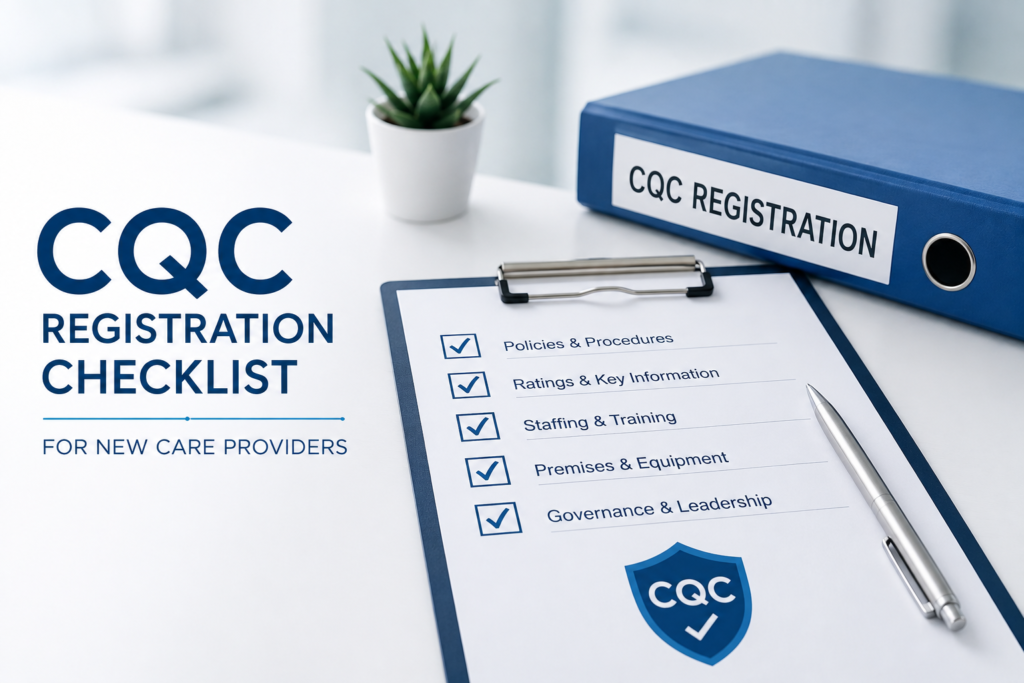
Starting a new care service involves more than completing a CQC application. Before applying, providers need to establish the correct regulated activities, appoint appropriate leadership, prepare governance systems and gather evidence that the proposed service can operate safely and effectively. The CQC registration process for new care providers is evidence-led. CQC needs to be satisfied […]
Common CQC Compliance Mistakes Care Providers Should Avoid
CQC compliance is an ongoing responsibility, not something care providers should address only when an inspection is approaching. Strong care provider compliance depends on accurate records, competent staff, effective governance and evidence that identified risks are being addressed. When these areas are neglected, small gaps can develop into significant CQC compliance issues. The most serious […]
ESG Due Diligence: What UK SMEs Need to Know When Dealing with Large Corporates
If you supply large companies — FTSE 350 businesses, multinational corporations, large financial institutions, or major public sector organisations — your ESG performance is increasingly subject to scrutiny that goes far beyond a brief tick-box questionnaire. Large corporates are under growing pressure from investors, regulators, and their own customers to manage the ESG risks across […]
What Is Forensic Accounting? A Plain-English Guide for UK Businesses
When a marriage or civil partnership breaks down and one or both parties own a business, the financial settlement process becomes significantly more complex. A business is not a liquid asset with an obvious market price. Its value depends on methodology, assumptions, and — critically — the accuracy and completeness of the financial information on […]
CQC Warning Notice for Medication Errors: What Care Homes Must Do
Medication management is one of the most frequently cited concerns in CQC inspection reports — and one of the most common triggers for Warning Notices under Regulation 12 (Safe Care and Treatment). The consequences of medication errors in care settings are serious: wrong doses, missed medications, or administration to the wrong resident can cause significant […]
How to Measure Your Carbon Footprint as a UK SME
For UK SMEs embarking on an ESG programme, measuring your carbon footprint is usually the right place to start on the environmental pillar. It produces a baseline — a quantified picture of your current greenhouse gas (GHG) emissions — against which future performance can be measured and targets can be set. Without a baseline, any […]
Building an ESG Strategy for Your UK SME: A Practical Step-by-Step Guide
An ESG strategy is not a glossy document produced for its own sake. For a UK SME, it is a structured approach to managing the environmental, social, and governance factors that affect the business’s long-term performance, its relationships with customers, employees, and investors, and its contribution to the communities in which it operates. The most […]
Forensic Accounting and Expert Witness Services: What UK Businesses Need to Know
When a commercial dispute reaches the courts or arbitration, financial questions are rarely simple. What was the true value of the business? How much did the fraud cost? What income was lost? What would have happened if the contract had been performed? These are not questions a judge or arbitrator can answer from legal training […]
Forensic Accounting for Insurance Claims: A UK Business Guide
When a business suffers a significant loss — a fire, a flood, a cyber attack, a major theft — the insurance claim that follows is rarely straightforward. Insurers are sophisticated commercial entities with experienced adjusters and, in significant claims, their own forensic accountants. Businesses that approach the claims process without specialist support frequently receive settlements […]
How Forensic Accountants Trace Hidden Assets in UK Disputes
When someone wants to hide money, they rarely simply put it under a mattress. Hidden assets in commercial fraud, divorce proceedings, and insolvency cases are typically concealed through layers of transactions, corporate structures, and financial arrangements designed to make the original source of the funds untraceable. Forensic accountants specialise in following the money — cutting […]